 Replication Results
Altmetric Attention Score
This badge shows attention from news, blogs, social media, policy documents, and more. View details
In Plain Terms
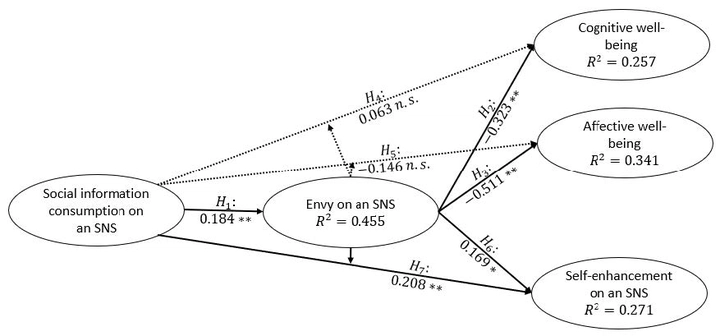
The authors re-ran a well-known 2015 study on how envy on social media affects well-being, this time using Instagram and U.S. college students instead of the original’s Facebook and German sample. Most of the original findings held up, supporting the idea that consuming others’ posts can fuel envy. One link, however, was weaker than before, suggesting the effect may shift across platforms, populations, or time, and inviting further study.
Related Papers
Cite this
APA Ampel, B. M., & Ullman, S. (2023). Why Following Friends Can Hurt You: A Replication Study. Transactions on Replication Research, 9(1). https://doi.org/10.17705/1atrr.00078
BibTeX
@article{ampel2023why,
  title={Why Following Friends Can Hurt You: A Replication Study},
  author={Benjamin M. Ampel and Steven Ullman},
  journal={Transactions on Replication Research},
  year={2023},
  doi={10.17705/1atrr.00078}
}
Benjamin M. Ampel
Assistant Professor in Computer Information Systems and Director, Center for CyberAI Research (CCAIR)
My research focuses on AI-enabled Cybersecurity, including Cyber Threat Intelligence, Large Language Models, and Phishing Detection.