Creating Proactive Cyber Threat Intelligence with Hacker Exploit Labels: A Deep Transfer Learning Approach
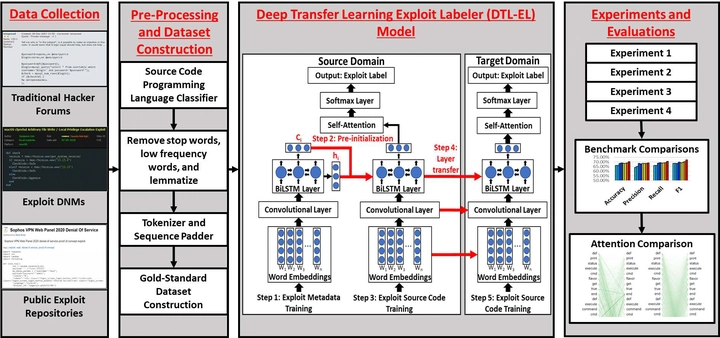 DTL-EL Research Design
Altmetric Attention Score
This badge shows attention from news, blogs, social media, policy documents, and more. View details
Dimensions Citation Metrics
Dimensions tracks citations across scholarly literature, patents, clinical trials, and policy documents. View full metrics →
This study introduces DTL-EL, a machine-learning system that automatically reads the exploits hackers post in online forums and labels what kind of threat each one is. To make its labels more accurate, it borrows knowledge from related sources such as darknet marketplaces and public exploit databases. In testing, it classified exploits more accurately than existing methods, helping defenders prioritize the most dangerous threats faster.
Watch a short video summary
Related Papers
Cite this
BibTeX
@article{ampel2024creating,
  title={Creating Proactive Cyber Threat Intelligence with Hacker Exploit Labels: A Deep Transfer Learning Approach},
  author={Benjamin M. Ampel and Sagar Samtani and Hongyi Zhu and Hsinchun Chen},
  journal={MIS Quarterly},
  year={2024},
  doi={10.25300/MISQ/2023/17316}
}
Benjamin M. Ampel
Assistant Professor in Computer Information Systems and Director, Center for CyberAI Research (CCAIR)
My research focuses on AI-enabled Cybersecurity, including Cyber Threat Intelligence, Large Language Models, and Phishing Detection.