Improving Threat Mitigation Through a Cybersecurity Risk Management Framework: A Computational Design Science Approach
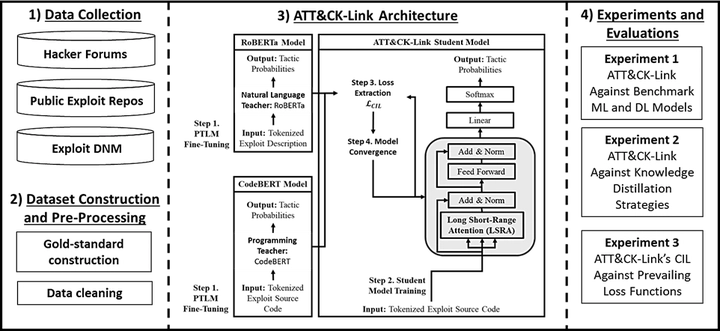 ATT&CK-Link Research Design
Altmetric Attention Score
This badge shows attention from news, blogs, social media, policy documents, and more. View details
Dimensions Citation Metrics
Dimensions tracks citations across scholarly literature, patents, clinical trials, and policy documents. View full metrics →
The authors built a tool called ATT&CK-Link that automatically connects threats discussed in underground hacker forums to MITRE ATT&CK, a widely used catalog of attacker tactics. By folding in data drawn directly from hackers, the system gives security teams earlier, more actionable warnings about emerging threats. The paper shows how an organization such as a hospital could use it to defend its systems before an attack lands.
Watch a short video summary
Related Papers
Cite this
BibTeX
@article{ampel2024improving,
  title={Improving Threat Mitigation Through a Cybersecurity Risk Management Framework: A Computational Design Science Approach},
  author={Benjamin M. Ampel and Sagar Samtani and Hongyi Zhu and Hsinchun Chen and Jay F. Nunamaker Jr.},
  journal={Journal of Management Information Systems},
  year={2024},
  doi={10.1080/07421222.2023.2301178}
}
Benjamin M. Ampel
Assistant Professor in Computer Information Systems and Director, Center for CyberAI Research (CCAIR)
My research focuses on AI-enabled Cybersecurity, including Cyber Threat Intelligence, Large Language Models, and Phishing Detection.