Publications

Creating Proactive Cyber Threat Intelligence with Hacker Exploit Labels: A Deep Transfer Learning Approach

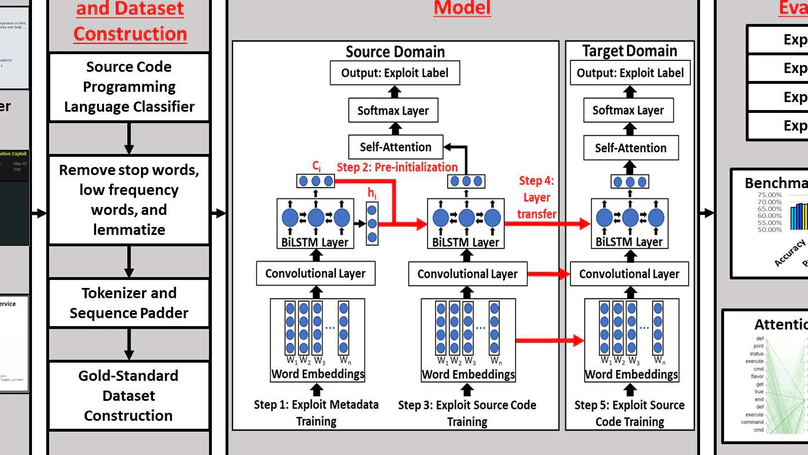
The rapid proliferation of complex information systems has been met by an ever-increasing quantity of exploits that can cause irreparable cyber breaches. To mitigate these cyber threats, academia and industry have placed a significant focus on proactively identifying and labeling exploits developed by the international hacker community. However, prevailing approaches for labeling exploits in hacker forums do not leverage metadata from exploit DarkNet Markets, or public exploit repositories to enhance labeling performance. In this study, we adopted the computational design science paradigm to develop a novel information technology artifact, the Deep Transfer Learning Exploit Labeler (DTL-EL). DTL-EL incorporates a pre-initialization design, multi-layer deep transfer learning (DTL), and a self-attention mechanism to automatically label exploits in hacker forums. We rigorously evaluated the proposed DTL-EL against state-of-the-art non-DTL benchmark methods based in classical machine learning and deep learning. Results suggest that the proposed DTL-EL significantly outperforms benchmark methods based on accuracy, precision, recall, and F1-score. Our proposed DTL-EL framework provides important practical implications for key stakeholders such as cybersecurity managers, analysts, and educators.

Improving Threat Mitigation Through a Cybersecurity Risk Management Framework: A Computational Design Science Approach

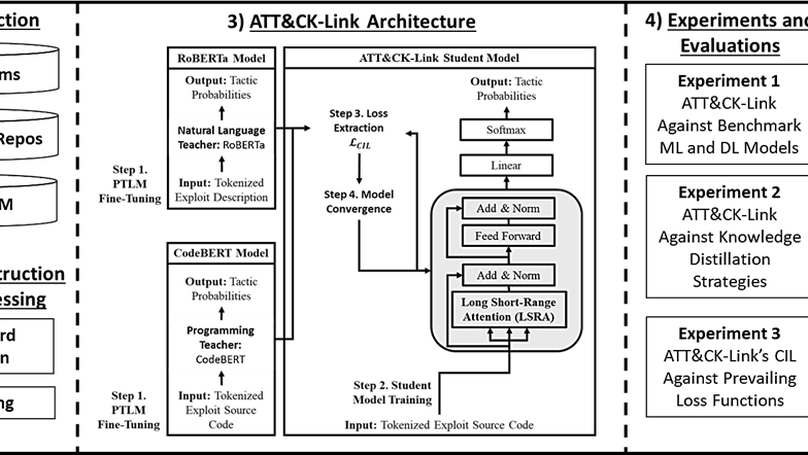
Cyberattacks have been increasing in volume and intensity, necessitating proactive measures. Cybersecurity risk management frameworks are deployed to provide actionable intelligence to mitigate potential threats by analyzing the available cybersecurity data. Existing frameworks, such as MITRE ATT&CK, provide timely mitigation strategies against attacker capabilities yet do not account for hacker data when developing cyber threat intelligence. Therefore, we developed a novel information technology artifact, ATT&CK-Link, which incorporates a novel transformer and multi-teacher knowledge distillation design, to link hacker threats to this broadly used framework. Here, we illustrated how hospital systems can use this framework to proactively protect their cyberinfrastructure against hacker threats. Our ATT&CK-Link framework has practical implications for cybersecurity professionals, who can implement our framework to generate strategic, operational, and tactical cyber threat intelligence. ATT&CKLink also contributes to the information systems knowledge base by providing design principles to pursue targeted cybersecurity analytics, risk management, and broader text analytics research through simultaneous multi-modal (e.g., text and code) distillation and classification.
Loading stats...